
Every year, around February and March, lakhs of Indian parents sit at the dining table with two school brochures in hand, trying to figure out which one will shape their child’s next ten or twelve years. This is the season when the question “ICSE vs CBSE: Which Board Is Better for Your Child?” stops being abstract and becomes a real decision with real consequences. Should your child sit for board exams designed by the Council for the Indian School Certificate Examinations, or would the Central Board of Secondary Education suit them better? Whichever way the decision goes, a reliable home tuition service in dehradun for both boards can make the transition smoother, since the right academic support adapts to either curriculum rather than forcing your child to adjust alone.
Understanding the Basics: What Do ICSE and CBSE Actually Mean?
Before comparing exam difficulty or career prospects, it helps to understand what these two acronyms stand for and which authority runs them. Many parents use the terms casually without knowing the administrative bodies behind each board, and that context actually matters when judging credibility, recognition, and curriculum philosophy.
Full Form of ICSE
The full form of ICSE is the Indian Certificate of Secondary Education. It is conducted by the Council for the Indian School Certificate Examinations (CISCE), a private, non-governmental board headquartered in New Delhi. CISCE was established in 1958 and also conducts the ISC (Indian School Certificate) examination for Class 12, along with the CVE (Certificate of Vocational Education). The board was created as an alternative to the Cambridge Overseas School Certificate, which is why its curriculum still carries a noticeably international flavour in subjects like English Literature and the sciences.
Full Form of CBSE
The full form of CBSE is the Central Board of Secondary Education. Unlike CISCE, CBSE is a government body under the Department of School Education and Literacy, Ministry of Education, Government of India. It was established in 1962 and is the most widely adopted school board in the country, with affiliated schools across India and in countries with significant Indian communities, including the UAE, Qatar, Kuwait, and Nepal. CBSE conducts the Class 10 (AISSE) and Class 12 (AISSCE) board examinations and follows the NCERT curriculum framework as its backbone.
Knowing these full forms isn’t just trivia. It explains why CBSE syllabi align so closely with competitive entrance exams set by central agencies, while ICSE’s privately designed curriculum often allows for more flexibility and depth in individual subjects.
ICSE vs CBSE: A Quick Snapshot Before the Details
If you’re short on time and need the headline differences before diving deeper, here’s a snapshot table covering the most commonly compared factors.
| Parameter | ICSE | CBSE |
| Full Form | Indian Certificate of Secondary Education | Central Board of Secondary Education |
| Governing Body | CISCE (private board) | Government of India |
| Established | 1958 | 1962 |
| Curriculum Style | Detailed, analytical, English-language focused | Concise, NCERT-based, exam-pattern focused |
| Number of Subjects (Class 10) | Generally 9-11 subjects | Generally 5-6 core subjects |
| Recognition | National and international | National, strong domestic competitive exam alignment |
| Best Suited For | Students inclined toward languages, humanities, detailed writing | Students preparing for engineering, medical, and other competitive entrances |
| School Availability | Concentrated in metros and select cities | Widely available across India, including smaller towns |
| Grading Pattern | Percentage-based with internal assessment | CGPA and percentage-based |
What is ICSE Syllabus? A Detailed Look
So, what is ICSE syllabus, exactly, and how does it differ in structure from what most Indian students are used to? The ICSE curriculum is built around comprehensive coverage of each subject rather than the leaner, exam-oriented structure CBSE uses. Students typically study nine to eleven subjects up to Class 10, spanning languages, sciences, mathematics, social studies, and at least one elective such as Computer Applications, Economics, or Environmental Science.
Subject Structure in ICSE
ICSE separates subjects with more granularity. Where CBSE often clubs Physics, Chemistry, and Biology under a single “Science” paper at the Class 10 level, ICSE frequently treats them as distinct, more detailed disciplines even before Class 11. English carries particular weight in the ICSE framework, split into English Language and English Literature, with the literature component demanding closer textual analysis, character study, and critical writing.
Emphasis on Application and Writing Skills
ICSE question papers traditionally reward descriptive, analytical answers over rote-learned, formulaic responses. This pushes students toward genuine comprehension and stronger written expression, which is one reason ICSE students are often described as having an edge in subjects like English, History, and Civics. Internal assessments, including practicals and projects, also carry meaningful weight toward the final score, encouraging steady, year-round engagement rather than last-minute exam cramming.
Who ICSE Suits Best
Students who enjoy reading, writing, and exploring subjects in depth, rather than racing through a syllabus for exam efficiency, tend to thrive under ICSE. It particularly benefits children likely to pursue humanities, law, journalism, or international higher education later, since the board’s emphasis on language and analytical writing translates well into those fields.
What is CBSE Syllabus? A Detailed Look
On the other side, what is CBSE syllabus built around, and why has it become the default choice for so many Indian families? CBSE follows the NCERT framework, which is more compact, standardised, and tightly aligned with national-level competitive examinations like JEE and NEET.
Subject Structure in CBSE
CBSE generally requires five core subjects at the Class 10 level: two languages (usually English and Hindi), Mathematics, Science, and Social Science. This leaner subject count, compared to ICSE’s broader spread, often means less academic load day-to-day, though the depth within each subject is still substantial.
Alignment With Competitive Examinations
This is arguably CBSE’s single biggest selling point. The NCERT textbooks that CBSE schools use form the foundation of question papers for JEE Main, JEE Advanced, and NEET. A student who has thoroughly studied CBSE Physics, Chemistry, and Mathematics from Class 11 and 12 already has a head start when competitive exam coaching begins, since they aren’t learning a separate framework alongside their school syllabus.
Who CBSE Suits Best
Students with clear ambitions toward engineering, medicine, or other mathematics-driven competitive fields generally find CBSE more efficient, since school study and exam preparation reinforce each other rather than pulling in two directions. CBSE’s nationwide footprint also matters practically: families who relocate across Indian cities due to transferable jobs often prefer CBSE because the curriculum stays consistent regardless of city or state.
ICSE vs CBSE: Detailed Comparison Across Key Factors
Now that the basics are clear, let’s go deeper into specific factors parents weigh most heavily when comparing the two boards.
1. Curriculum Depth and Subject Count
ICSE’s broader subject spread builds well-rounded general knowledge but adds to the academic workload, particularly in middle and high school. CBSE’s narrower, NCERT-anchored syllabus is lighter on subject count but demands strong conceptual command within each subject, especially in Mathematics and Science, since competitive exams test depth rather than breadth.
2. Language and Literature Focus
This is where ICSE has a distinct advantage. The board’s English syllabus, split across Language and Literature papers, exposes students to a wider range of texts, prose styles, and poetry analysis. CBSE’s English curriculum, while solid, is generally less intensive in literary analysis and more focused on functional language skills and comprehension.
3. Internal Assessment Weightage
ICSE places considerable weight on internal assessments, practicals, and project work, sometimes up to 20% of the final score in several subjects. CBSE also includes internal assessment, but the weightage varies more by subject, with board exams traditionally carrying a heavier share of the final result from Class 10 onward.
4. School Availability and Infrastructure
CBSE schools are present in almost every Indian city, town, and semi-urban region, making it the practical default for many families simply due to availability. ICSE schools tend to be concentrated in metro cities and larger towns, which can be a genuine constraint for families outside major urban centres, including parts of Uttarakhand.
5. Grading and Result Patterns
Both boards have moved toward grade-based reporting alongside raw percentages, but the systems aren’t identical, which we’ll cover in detail in the next section.
Grading System Comparison: ICSE Grades vs CBSE Grades
Grading confusion is one of the most common reasons parents get stuck comparing report cards from different boards. Here’s how the two systems actually work.
CBSE Grading System
CBSE uses a Cumulative Grade Point Average, or CGPA, system for Class 10, alongside the traditional percentage. Marks are converted into grade points on a 9-point scale, as shown below.
| Marks Range | Grade | Grade Point |
| 91-100 | A1 | 10 |
| 81-90 | A2 | 9 |
| 71-80 | B1 | 8 |
| 61-70 | B2 | 7 |
| 51-60 | C1 | 6 |
| 41-50 | C2 | 5 |
| 33-40 | D | 4 |
| 21-32 | E1 | Qualified |
| 00-20 | E2 | Qualified |
To convert CGPA to an approximate percentage, CBSE traditionally used the formula: Percentage = CGPA × 9.5. So a CGPA of 9 would roughly translate to 85.5%, though many schools and universities now ask for the raw percentage directly for admissions purposes.
ICSE Grading System
ICSE has historically relied more on direct percentage scoring rather than grade-point conversion, though grade indicators are also issued alongside marks for reference. Class 10 ICSE results are typically reported subject-wise in percentages, with internal assessment marks added to the final written score for a composite total.
| Aspect | ICSE Approach | CBSE Approach |
| Primary Reporting | Percentage with grade indicators | CGPA and percentage |
| Pass Threshold | Generally around 35% per subject | Generally around 33% per subject |
| Internal Assessment Inclusion | Built into the final percentage | Reported separately in many cases |
| University Admission Calculations | Percentage used directly | Percentage derived from CGPA, or direct marks |
Because Indian universities and many international institutions ask for percentage figures during admissions, students from both boards generally convert results into comparable percentage terms before applying, so the grading format rarely becomes an obstacle later.
Is CBSE Harder Than ICSE? Breaking Down the Real Difficulty Factor
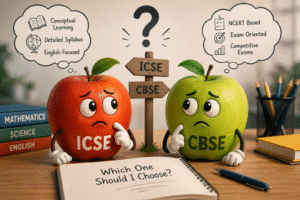
This is probably the single most searched question on this topic, and the honest answer is more nuanced than a simple yes or no. So, is CBSE harder than ICSE, or is it the other way around?
Where CBSE Feels Harder
CBSE’s Mathematics and Science syllabi, particularly from Class 9 onward, are intentionally aligned with the conceptual rigor expected in JEE and NEET preparation. For a student who isn’t naturally strong in numerical or scientific reasoning, this can feel demanding, since there’s limited room to compensate through language-based subjects, given the smaller subject count.
Where ICSE Feels Harder
ICSE, by contrast, can feel harder for students who struggle with extensive writing, detailed literary analysis, or managing a heavier subject load across nine or more subjects. The English Literature paper, with its nuanced interpretation of prose and poetry, is often cited by students as more demanding than CBSE’s comparatively functional English curriculum.
So Which Board is Actually Difficult? ICSE vs CBSE Which is Difficult, Really?
When people ask “ICSE vs CBSE which is difficult,” the more accurate framing is that both boards are difficult in different directions. CBSE concentrates its difficulty into fewer, deeper subjects with strong quantitative demands. ICSE spreads its difficulty across more subjects with strong qualitative and analytical demands. A student who finds calculations intuitive but dreads long-form writing will likely find CBSE more comfortable. A student who enjoys reading, debating, and writing essays but finds advanced mathematics stressful will likely find ICSE the gentler path, despite its larger subject count.
This is precisely why a blanket online answer rarely works for an individual child. A personalised academic assessment, ideally through proper career counselling, tends to give far more reliable direction than generic forum opinions, because it actually accounts for the student’s specific strengths, interests, and long-term goals rather than treating every child as the same statistical average.
Difference Between CBSE and ICSE: Career and Higher Education Impact
Parents rarely choose a board purely on subject preference; the long-term career trajectory weighs heavily on the decision too. Let’s examine how the difference between CBSE and ICSE plays out once a student moves toward higher education and careers.
Engineering and Medical Entrance Exams
CBSE’s NCERT-based syllabus directly overlaps with JEE and NEET question patterns, giving CBSE students a structural advantage in early preparation, since their school textbooks and exam material are largely the same source. ICSE students aiming for engineering or medicine aren’t disadvantaged in ability, but typically need to supplement school study with NCERT material from Class 11 onward to bridge that syllabus gap.
Humanities, Law, and Civil Services
ICSE’s stronger foundation in English, History, and analytical writing tends to benefit students heading toward law, journalism, civil services, or humanities-based university programs. The board’s emphasis on argumentative and descriptive writing from an early age builds skills that map well onto entrance exams like CLAT or essay-based components in civil services preparation.
International Education
For families considering undergraduate study abroad, ICSE’s curriculum structure and grading style are often viewed as slightly more compatible with international admission processes, particularly in the UK, given the board’s historical roots in international examination patterns. That said, CBSE is also widely recognised internationally today, and the gap has narrowed considerably as more students from both boards study abroad successfully.
Domestic University Admissions
For admission into Indian universities, particularly under the Common University Entrance Test framework now used by many central universities, the board matters less than the percentage or equivalent score achieved, since most admission processes normalise scores across boards rather than favouring one.
Best Board in India: Is There Really a Single Right Answer?
Search engines are flooded with queries asking for the best board in India, but the honest, research-backed answer is that there is no universal best board, only a best fit for a particular child’s learning style, family circumstances, and future direction.
Factors That Actually Determine “Best Board in India for Education”
When people search for the best board in India for education, they’re usually looking for a checklist they can apply to their own situation. Here’s a practical one:
- Child’s learning style – Does your child grasp concepts faster through structured, concise material (favouring CBSE), or do they engage better with detailed, descriptive content (favouring ICSE)?
- Career direction, if already clear – Engineering or medical aspirations generally align better with CBSE’s NCERT structure; humanities, design, or law often align better with ICSE’s analytical depth.
- School availability in your city – A board’s theoretical advantages mean little if there’s no good school offering it within a reasonable distance.
- Mobility needs – Frequently relocating families, especially government or defence service families, often prefer CBSE for its consistency across India.
- Language and writing comfort – Children who enjoy reading and writing extensively tend to find ICSE more rewarding rather than burdensome.
Why “Best” Depends on the Child, Not the Board
Two children in the same family, taught by the same parents, can have completely different academic strengths. One might be a natural at mathematics and logical reasoning, suited to CBSE’s competitive-exam alignment. The other might thrive on reading, discussion, and written expression, better matched to ICSE. Treating “best board” as a fixed ranking, rather than an individual fit assessment, is where most parents go wrong.
ICSE Board vs CBSE Board: A City-Level Reality Check
Beyond curriculum philosophy, there’s a very practical dimension to the ICSE board vs CBSE board debate: which one is actually accessible where you live. In cities like Dehradun, school availability genuinely shapes the decision more than theoretical curriculum comparisons do.
Availability in Tier-2 Cities Like Dehradun
Dehradun, known for its strong educational ecosystem, offers a healthy mix of both CBSE and ICSE institutions, though CBSE schools remain more numerous overall, mirroring the national pattern. Families in the city genuinely have a real choice between both boards, more than can be said for smaller towns where ICSE options remain limited.
Why Local Academic Support Matters More Than the Board Itself
Regardless of which board a child is enrolled in, consistent academic support outside school hours often makes a bigger difference to outcomes than the board’s design. This is where structured, localised support becomes valuable. Families in Dehradun increasingly rely on professional career counselling in Dehradun to decide not just which board suits their child, but which subject streams and career paths make sense well before Class 10 arrives, rather than scrambling for direction after results are out.
Similarly, when academic gaps appear, whether in ICSE’s demanding writing assignments or CBSE’s concept-heavy mathematics, having access to the best home tutor in Dehradun can directly address subject-specific struggles without forcing a child to switch boards mid-way, which is rarely a smooth transition. One-on-one guidance, tailored to whichever board a student is enrolled in, consistently produces better outcomes than generic group coaching that ignores board-specific syllabus differences.
For families managing multiple children, or those in residential communities where several households face the same academic decisions, organised colony tuition services in Dehradun have also become a practical solution, offering doorstep support that adapts to both ICSE’s detailed subject demands and CBSE’s exam-oriented structure within the same neighbourhood setup.
Making the Final Decision: A Practical Checklist for Parents
If you’ve read this far, you likely already have a working sense of which board leans toward your child’s strengths. Here’s a structured checklist to finalise the decision with confidence rather than lingering doubt.
Step 1: Assess Academic Inclination Honestly
Sit down without exam pressure in the room and observe, over a few weeks if possible, whether your child naturally gravitates toward solving numerical problems or toward reading, storytelling, and writing tasks. This single observation often predicts board-fit better than any rankings article.
Step 2: List Genuinely Accessible Schools
Rather than starting with “which board is better,” start with “which good schools, of either board, are within a reasonable commute.” A mediocre school of the theoretically better board rarely outperforms an excellent school of the other board.
Step 3: Talk to Current Students and Parents
Direct conversations with families whose children are currently studying in ICSE or CBSE schools in your city reveal far more practical, current information than older online comparisons, since curriculum updates and school quality both shift over time.
Step 4: Consider Professional Guidance Early
A short, structured counselling session, ideally before Class 9, can clarify stream choices, board fit, and even early career direction, saving years of course correction later. This is particularly valuable for families undecided between the two boards or unsure how either path connects to their child’s eventual career goals.
Step 5: Stay Flexible on the “Forever” Mindset
Board choice matters, but it isn’t permanently irreversible in the way it’s sometimes presented. Many students do transition between boards, particularly at the secondary-to-senior-secondary transition, when circumstances genuinely require it, though this is best treated as an exception rather than a backup plan.
If you’d like personalised guidance on this decision, or want to discuss your child’s specific academic profile with experienced counsellors, you can always reach out directly for a one-on-one conversation rather than relying solely on generic online comparisons.
Common Myths About ICSE and CBSE That Need Correcting
A lot of misinformation circulates around this topic, often repeated so often that it’s accepted as fact without scrutiny. Let’s address a few persistent myths.
Myth 1: “ICSE is Only for Elite or Wealthy Families”
While ICSE schools have historically been associated with premium fee structures in certain cities, this isn’t a rule, and many mid-range ICSE schools exist with reasonable fee structures, particularly outside the largest metros.
Myth 2: “CBSE is Always Easier”
CBSE’s narrower subject count doesn’t automatically translate into lower difficulty. Its Mathematics and Science syllabi, especially from Class 9 onward, are deliberately rigorous to prepare students for competitive exams, which can feel far more demanding than ICSE’s broader but more descriptively assessed subjects.
Myth 3: “You Can’t Switch Boards Once You Start”
While switching boards mid-way isn’t ideal and does require some academic adjustment, it isn’t impossible, particularly at natural transition points like the end of Class 8 or Class 10, when school changes are already common for other reasons.
Myth 4: “One Board Guarantees Better College Admissions”
University admissions, particularly in India, generally normalise scores across boards rather than favouring one outright. A strong, consistent academic record matters more than the specific board name on the certificate.
Frequently Asked Questions on ICSE vs CBSE
Which board is better, ICSE or CBSE, for a child planning to take JEE or NEET later?
CBSE generally offers a smoother path for JEE and NEET preparation, since its Class 11 and 12 NCERT-based syllabus directly overlaps with the question patterns used in these competitive exams. ICSE students can still succeed, but they usually need additional NCERT-based preparation alongside their regular school syllabus from Class 11 onward.
Is the ICSE syllabus tougher than the CBSE syllabus overall?
Neither syllabus is universally tougher; the difficulty depends on subject orientation. ICSE involves more subjects and heavier writing and literary demands, while CBSE concentrates difficulty into fewer, more conceptually intense subjects, particularly Mathematics and Science. A student’s natural strengths determine which feels harder in practice.
Can a student switch from ICSE to CBSE or vice versa during school years?
Yes, switching is possible, and it happens fairly often, particularly around Class 8 or after Class 10 board results. The transition requires some adjustment time, especially in subjects with different syllabus depth, but it isn’t a rare or unusual move among Indian school families.
Does CBSE or ICSE have better recognition for international university admissions?
Both boards are recognised internationally today. ICSE’s curriculum structure has historically aligned somewhat more closely with certain international examination patterns, but CBSE’s widespread global presence, particularly across the Middle East and parts of Asia, means international universities are equally familiar with CBSE transcripts.
Which board has a higher pass percentage typically, ICSE or CBSE?
Pass percentages fluctuate year to year and shouldn’t be the sole basis for board selection, since they’re influenced by factors like overall student population size, regional school quality, and grading leniency in a given academic year, rather than reflecting one board being inherently “easier” to pass.
Is it true that ICSE focuses more on practical and project work than CBSE?
Yes, this is broadly accurate. ICSE traditionally assigns meaningful weightage to internal assessments, practical work, and projects across many subjects, often more structured than CBSE’s internal assessment component, which encourages consistent academic engagement throughout the year rather than concentrated exam-time effort.
Should the choice between ICSE and CBSE depend on the city we live in?
To a significant extent, yes. School availability genuinely shapes practical choice. In cities with limited ICSE schools, pursuing CBSE simply because of better school options and infrastructure can be a more sensible decision than chasing a board with weaker local representation, regardless of theoretical curriculum preferences.
Final Thoughts: Choosing What’s Right, Not What’s “Best” on Paper
The debate around ICSE vs CBSE will likely continue indefinitely online, with countless articles claiming a definitive winner. But after examining curriculum depth, subject structure, grading systems, exam difficulty, and career alignment, the clearest takeaway is that board selection isn’t about chasing a universally superior system. It’s about matching a board’s natural strengths to your specific child’s learning style, your family’s practical circumstances, and the academic path you’re realistically working toward.
If your child loves numbers, structured problem-solving, and is already eyeing engineering or medical entrance exams, CBSE’s tight NCERT alignment will likely serve them well. If your child is a natural reader, enjoys detailed writing, and seems drawn toward humanities, law, or design, ICSE’s analytical depth could be the more rewarding environment. Neither choice closes doors permanently, and both boards have produced successful, well-rounded students across every conceivable career field.
What matters most, beyond the board itself, is consistent academic support, honest assessment of your child’s genuine interests, and timely professional guidance when the decision feels overwhelming. For families in Dehradun navigating this exact crossroads, combining the right board choice with structured tutoring support and early career counselling tends to produce far better long-term outcomes than fixating on which board wins an online debate. You can explore more academic guidance resources on the Doon Thinker or get in touch for a personalised consultation tailored to your child’s specific academic journey.